
As the seasons start to change, they change you, too! It’s fall now, which is my favourite season, because you can feel the change so strongly: in the vibrant colours, harvest foods, the chill in the air. But I remember when autumn used to come with a whole bunch of reasons to drink (or reasons that I couldn’t possibly stop). So, in this post I want to talk about something related to the seasons changing which:
- Has been scientifically verified
- Is of great importance to anyone trying to quit alcohol, or anything, really.
- Really sucks.
I think it’s the last of these three points that is the reason why this information hasn’t been spread widely, because when you first hear it, the conclusion is kind of depressing, and there’s no easy solution…But knowing about it can take some of the sting out of it, so here we go!
Environmental Cues vs. Cravings
Anything in your environment that encourages, reminds, or in any way gets you to drink is an environmental cue. They can be quite obvious, like alcohol advertisements, smells, or being around other people who are drinking. Or they can be far more subtle: things like longer nights, cold days, indoor gatherings, all sorts of personal and maybe quite pleasurable associations that have become associated with drinking. We have all felt these and know how they work to some extent — but when you quit, they can seem to jump out at you from everywhere, and they can be extremely powerful, all the more so because they seem like harmless little nudges.
Of course, these cues affect some people more strongly than others, just like all the other issues that keep people drinking. They might be something that you really struggle with, especially if you can’t get away from them because of something like family, friends, or work. Or they might not seem as important to you as other things, but watch out, because they are often sneaky, waiting until you are at your most vulnerable to pounce. I used to have a keychain that reminded me to drink every day on my way home, but I would have told you that was a silly idea right up to the moment I realized I had to get rid of it.
Anyway, the bad news for people quitting alcohol is that these cues take longer than you might think to pass. In fact, unlike cravings, they get worse for the first three months (an effect known as the “incubation of craving”) (Li et al., 2015; Treloar Padovano & Miranda, 2021). This is a very strange result, and it has surely trapped many people who, happy that their physical cravings are noticeably reduced, head off full of confidence to the old drinking haunt, holiday, or other high-pressure environment — not knowing they are actually more vulnerable than when they first quit.
How much more vulnerable? And for how long? Unfortunately, this is a really hard area to study and it’s underfunded, so all we know is that cues don’t get any better for three months for other drugs, and it’s at least two months for drinking (Wang et al., 2013; Li et al., 2015). So, something like this:
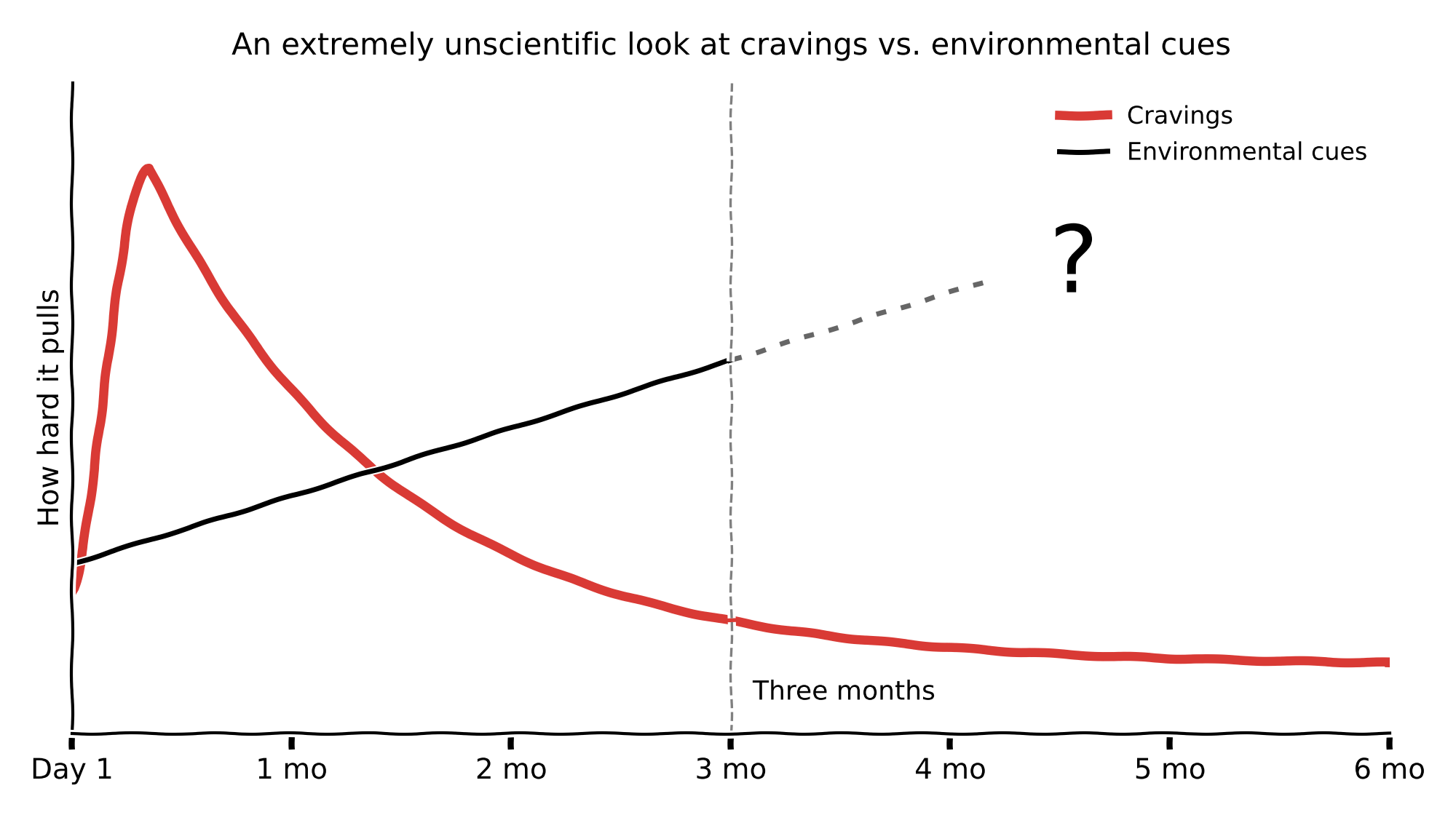
Where does this leave us, and why is it important? Well, if you’ve quit for two months and don’t feel the real need for a drink like you used to, but when you go out dancing with your friends you’re starting to feel like just one or two would be OK… well, yeah! That’s because you’re feeling the claws of environmental cues right when you would expect them to be at their worst, eclipsing the more physical pull of alcohol. Hang in there, you’re right on track. For a summary of other pros and cons you can expect depending on the day, check out the Map of Quit.
I say this is a little depressing because if you’re on day one, environmental cues are going to get worse before they get better. And nobody has studied exactly when, on average, they taper off for alcohol. I think physical cravings are far more uncomfortable for most people, but that doesn’t feel like a good (or even fair) result after months of hard work.
The good news is that, boy, they do taper off! For me it was at about a year. In fact, some of the things that used to be powerful cues for me now fascinate me because they seem so ridiculous. I do not miss $20 beers at the ballgame in the slightest, or sleeping away my hard-earned vacation days, although those used to be two of the most difficult environments in which to stay sober.
But that’s just the way it is — the strange pull of memories and old haunts and habits that make up environmental cues is an unpleasant mystery that can stick around for a long time if you’re the kind of person who is affected by them. It can also overlap with the “dopamine trough” (as I like to call it) a few months in, when the other systems that keep you active and distracted from falling into old ruts haven’t kicked in yet.
Knowing is half the battle — for a tool to audit your own physical environment for cues, scan this QR code:
Sources
- Li, P., Wu, P., Xin, X., et al. (2015). Incubation of alcohol craving during abstinence in patients with alcohol dependence. Addiction Biology, 20(3), 513–522. doi:10.1111/adb.12140
- Treloar Padovano, H., & Miranda, R. (2021). Incubation of alcohol craving as it naturally occurs in a developmentally diverse sample of dependent and nondependent drinkers. Addiction Biology, 26(3), e12934. doi:10.1111/adb.12934
- Wang, G., Shi, J., Chen, N., et al. (2013). Effects of length of abstinence on decision-making and craving in methamphetamine abusers. PLoS ONE, 8(7), e68791. doi:10.1371/journal.pone.0068791
Marginalia